macOS · AppKit + WKWebView · Apple Foundation Models · SQLite · Local embeddings
Locker
Your inbox. Your Mac. Your call.
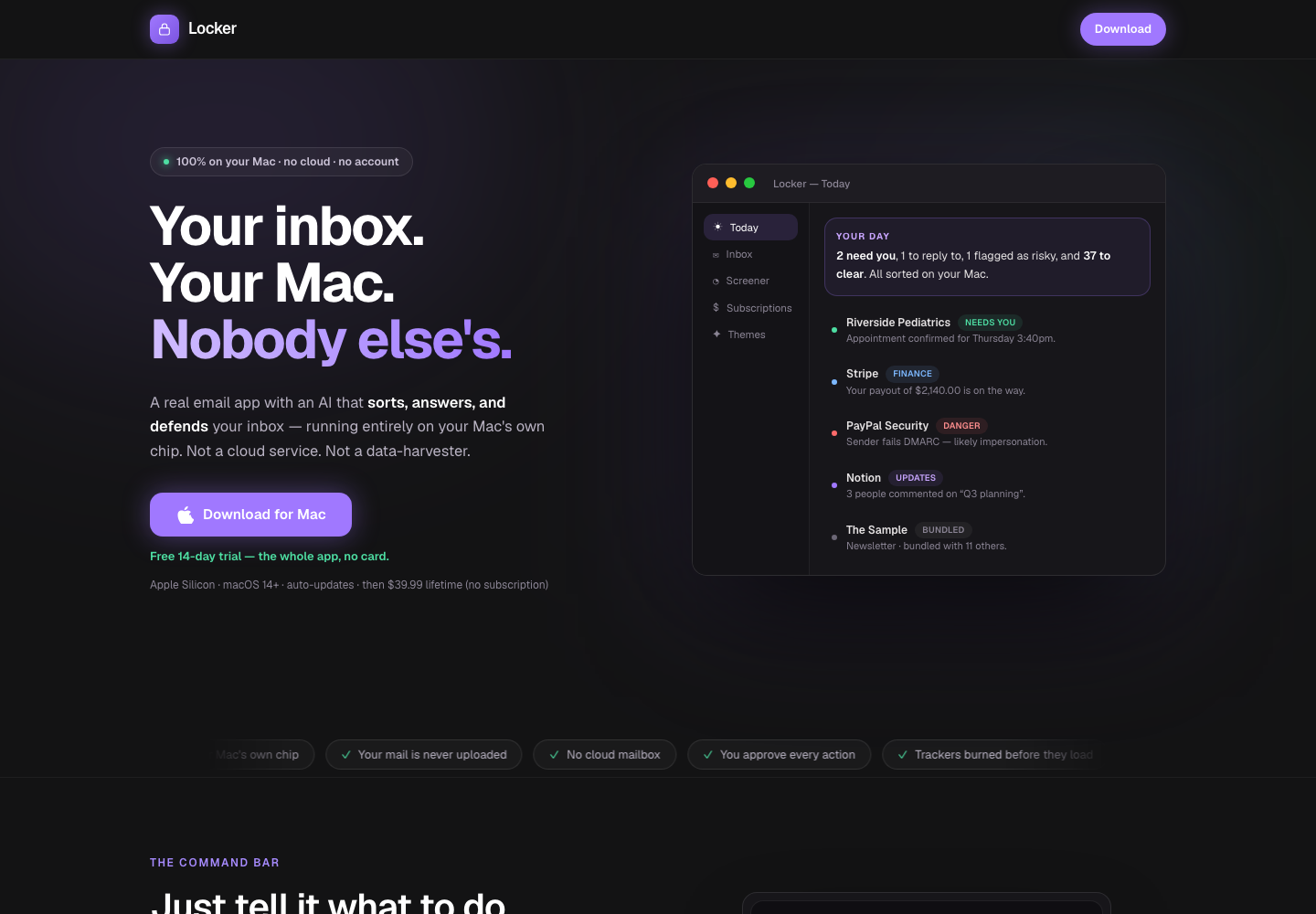
Locker is a private inbox for the Mac, not simply an automation layer over Apple Mail. A native shell brings together a local interface, mail services, on-device intelligence, and meaning-based search. The Today view organizes attention into priority items, flags, suggested replies, and a review path for the rest.
Origin
How it started
An inbox holds years of decisions, relationships, and context. I wanted useful intelligence without first making a remote copy of all of it. Locker began with local mail automation and grew into a standalone application, with the interface and the processing close to the person who owns the mail.
Features
What it does
A Mac application, end to end
An AppKit shell hosts the local interface in WKWebView and coordinates bundled services, native notifications, attachments, and updates. Mail connectivity includes IMAP and a separate Apple Mail bridge.
Intelligence on the device
A Swift helper integrates Apple Foundation Models for supported Macs. Local triage and summaries are designed to work beside the inbox; availability depends on the device and its model support.
Search by meaning, locally
A bundled MiniLM embedding model and SQLite-backed storage keep the semantic index on the Mac. Remote model downloads are disabled in the embedding configuration.
An inbox with boundaries
The screener, drafts, and review-oriented controls make intervention visible. The goal is useful assistance with room for a person to check an action before committing to it.
A daily view of the work
The Today dashboard brings together priority messages, radar flags, suggested replies, subscription navigation, and a review-and-clear entry point. AI judgments still need scrutiny; a confident label is not proof of correctness.
Under the hood
Engineering
Native does not have to mean one rendering technology
The application combines AppKit and WKWebView with bundled local services. That split makes the mail and intelligence pipeline available to a rich interface while preserving native integration points such as notifications, file handling, and updates.
Privacy is a set of explicit boundaries
Local mail storage, a bundled embedding model, and on-device inference reduce reliance on remote processing. That does not mean the app never connects to the network: mail providers, licensing, updates, and optional cloud integrations have separate boundaries that must be described honestly.
Do not make the inbox wait for the whole pipeline
The v0.5.17 release work separates import, triage, and backfill from waiting on every AI result. A usable inbox should not be held hostage by the slowest stage of its enrichment pipeline.
Stack
- macOS · Swift · AppKit
- WKWebView
- Apple Foundation Models
- TypeScript · Next.js
- Bundled local Node services
- Prisma · SQLite
- MiniLM local embeddings
- IMAP · Apple Mail bridge
- Sparkle updates